
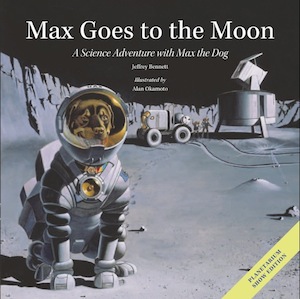
 Max Goes to the Moon was illustrated by Alan Okamoto. Alan worked from real models for the main characters (Tori and Max) who posed for the scenes; he then added the backgrounds as needed for the different Earth and space scenes. Additional characters were sometimes based on real people and sometimes not. Below is a list of some special things to look for in the paintings. We have also included a few other special notes of interest.
- p. 3: Tori, modeled by Maddy Hemmeter, is shown in her room dreaming about the future. Notice Max visible through her open doorway. Also notice some of the details of the paintings on her walls, and so on. You’ll also see a Hawaiian lei hanging on the painting of the rocket at liftoff, put there to honor the Hawaiian heritage of Maddy’s family.
- p. 5: Notice the frisbee with the logo of the dove flying over Earth toward the Moon, and the olive branches around the edges. This symbolizes our hopes and dreams that returning to the Moon can help bring about an era of world peace.
- p. 6-7: The street scene shows the view looking west toward the mountains down Pearl Street in Boulder, Colorado. The buildings, however, include a combination of buildings with meaning to the artist, some from Boulder and others from his home town of San Francisco. A key feature of this painting is the waning gibbous moon in the morning sky, as explained in the Big Kid boxes on these pages. Also notice the ambulance with sirens blaring at the top of the hill on the left — this is what Max was really howling at when they thought he was howling at the Moon.
- FAQ: Is there another book that describes how Max became a hero on the Space Station?
- Answer: Yes! The prequel Max Goes to the Space Station will be published in late 2013.
- p. 8: Artist Alan Okamoto chose to show an “infinite time” scene here: Notice that the photographer is taking a picture of Max as he brings in a newspaper that already contains the photo of him bringing in the newspaper, which in turn shows the same photo, and so on to infinity.
- p. 9: The space station shown here is similar but not identical in appearance to the International Space Station now in Earth orbit. Near the lower left you can see a round section with four legs — that is the moonship that you’ll see heading toward the Moon on later pages.
- p. 10: Notice the full Moon rising up in this scene, which tells us that it takes place in the early evening. Since the Moon is rising, we must be looking toward the east.
- p. 11: This scene is based on the water tank in which astronauts really do train. It is located at the Johnson Space Center in Houston, Texas.
- p. 12-13: This scene is based on photographs of what it really looked like when the Apollo 11 astronauts visited the Moon in July, 1969.
Note: If you have the old edition of the book, there is an error in the discussion of the flag in the Big Kid Box on p. 12; if you have the new Planetarium Show Edition, it is all correct. - p. 14-15: The five small vignettes on this page spread show a sequence of scenes from the trip to the Moon. First we see the astronauts walking toward the rocket that takes them to the Space Station. The second circle shows the launch. The third circle shows the ship docked (in the foreground) at the Space Station; notice the round moonship on the opposite side of the station, near the upper left of the circle. In the fourth circle you can see the moonship starting to move away from the Space Station; the rocket from Earth is still docked at the lower right. The fifth and final circle shows the moonship landing on the Moon.
- p. 18-19: Be sure to notice that the shadow of the rock, from which Max is leaping back, is pitch black; the reason is explained in the Big Kid Box on p. 18. Also notice the clear “fence” that the astronauts have placed around Max’s first paw prints, and Tori pulling her frisbee from her backpack.
- p. 20: Tori’s feather and rock demonstration is based on the real demonstration conducted by Apollo 15 astronaut Dave Scott (click here for video). Also: As Tori drops the rock and feather to demonstrate that everything falls at the same rate on the airless Moon, you may see in the distant background that another astronaut caught the frisbee that Max missed.
- p. 21: Notice the crescent Earth in the sky.
- p. 22: Notice that Earth is moving toward first quarter, which is an indication that night is coming for their location on the Moon.
- p. 26-27: This scene takes place much later than the earlier Moon scenes, since it shows a Moon colony that has been constructed. Notice the gibbous Earth in the sky — which we chose to echo the gibbous Moon that we saw back on p. 6-7. You’ll see that this particular Moon colony has been built so much of it is underground — which shields it from dangerous radiation from the Sun — but has some areas covered by the dome to allow some sunlight in.
- The artist chose to show the gibbous moon and Earth in the story at the author’s request, because the author originally came up with the idea for the story when walking with Max and his young son one morning, when the gibbous moon was visible in the sky.
- p. 28-29: Notice that the Sun is up in the sky (almost directly over Max’s head in the painting), but we can still see stars because the Moon has no air to scatter sunlight across the sky.