
The free Totality app was created by Big Kid Science, which subsequently donated the app to the American Astronomical Society (AAS).
For additional eclipse information beyond what you find within the Totality app, please visit the American Astronomical Society (AAS) Eclipse Pages (eclipse.aas.org).
Safe Viewing Warning
Never look directly at the Sun without certified solar filters or eclipse glasses that meet the ISO 12312-2 standard. This is true even when a partial eclipse blocks more than 99% of the Sun. The only exception occurs when the Sun is completely blocked during the brief moments of totality for those on the path of totality.
Two Ways to Safely View an Eclipse
Young child warning: Closely monitor young children to make sure they do not risk damaging their eyes by looking at the Sun during the partial phases of the eclipse. Why this is necessary: young children ordinarily won’t stare at the Sun because it hurts too much, but the pain is lessened during a partial eclipse, making it critical that you pay attention to their eye safety.
You know that it is unsafe to look directly at the Sun on a normal day, and eclipse day is no different. This means you have two basic options for observing a solar eclipse:
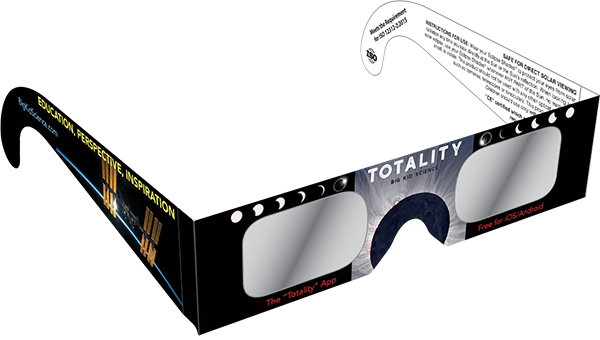
- Use certified solar filters meeting the ISO 12312-2 international standard per the instructions below. (Do not use ordinary sunglasses or any other type of homemade filter!) You can be confident in your filters or eclipse glasses if they are supplied by a manufacturer on the American Astronomical Society’s safe supplier list. One option to consider is the The “Totality App” eclipse glasses (manufactured by Rainbow Symphony). Note: Young children may do better with hand-held “solar viewers” than with standard eclipse glasses, which may be too large for their heads.
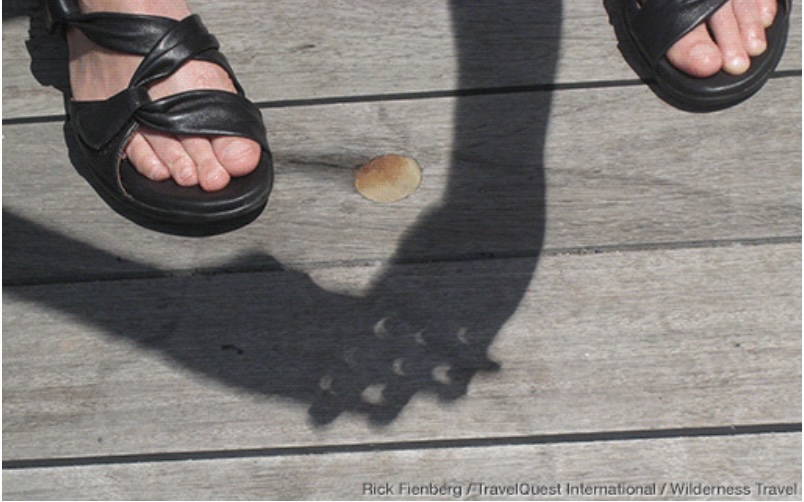
- Use an indirect projection technique, such as pinhole projection. The simplest way to do this is by cross-hatching your fingers so that sunlight shines through the small spaces between them (photo below). This will allow you to watch the progression of the eclipse without looking directly at the Sun. Other projection techniques are discussed on this “indirect viewing” page from the American Astronomical Society and in our “See Totality!” video introduction.
Instructions for the Safe Use of Solar Filters/Viewers
This section taken directly (with permission) from this page from the American Astronomical Society.
Instructions for All Solar Eclipses
- Always inspect your solar filter before use; if scratched, punctured, torn, or otherwise damaged, discard it. Read and follow any instructions printed on or packaged with the filter.
- Always supervise children using solar filters.
- If you normally wear eyeglasses, keep them on. Put your eclipse glasses on over them, or hold your handheld viewer in front of them.
- Stand still and cover your eyes with your eclipse glasses or solar viewer before looking up at the bright Sun. After looking at the Sun, turn away and remove your filter — do not remove it while looking at the Sun.
- Do not look at the uneclipsed or partially eclipsed Sun through an unfiltered camera, telescope, binoculars, or other optical device.
- Similarly, do not look at the Sun through an unfiltered camera, telescope, binoculars, or any other optical device while using your eclipse glasses or handheld solar viewer in front of your eyes — the concentrated solar rays could damage the filter and enter your eyes, causing serious injury.
- Seek expert advice from an astronomer before using a solar filter with a camera, telescope, binoculars, or any other optical device; note that solar filters must be attached securely to the front of any telescope, binoculars, camera lens, or other optics.
Additional Instructions for Total Solar Eclipses
- If you are inside the path of totality, remove your solar filter only when the Moon completely covers the Sun’s bright face and it suddenly gets quite dark. Experience totality, then, as soon as the bright Sun begins to reappear, replace your solar viewer to look at the remaining partial phases. Note that this applies only to viewing without optical aid (other than ordinary eyeglasses). Different rules apply when viewing or imaging the Sun through camera lenses, binoculars, or telescopes; consult an expert astronomer before using a solar filter with any type of magnifying optics.
- Outside the path of totality, and throughout a partial or annular solar eclipse, there is no time when it is safe to look directly at the Sun without using a special-purpose solar filter that conforms to the ISO 12312-2 international standard.
Eclipse Observing with Binoculars, Telescope, or Camera
Similar safety warnings apply if you want to view the eclipse with binoculars, a telescope, or a camera, but in addition, you must protect the optics of your viewing instrument. This means you will need to purchase safe “solar filters” for your instrument. Once the filters are installed, you again have two basic options:
- Look through the instrument (binoculars, telescope, camera) toward the Sun. Again, be sure the solar filters are properly installed, and that your no other sunlight is coming through anywhere into your eyes.
- Hook up a camera that will allow you to project the image onto a computer or other screen.
For additional information on solar filters for telescopes, binoculars, and cameras, please see this page from the American Astronomical Society.
Eclipse Photography
If you will be on the path of totality and are thinking about trying to photograph the total eclipse, our basic recommendation is to skip it unless you are a professional photographer. Why? Because at best you will have only a few short minutes of totality, and you don’t want to miss out on this awe-inspiring experience because you are fiddling around with a camera.
That said, if you insist on trying to take your own pictures, you should study and prepare beforehand. Try starting with this excellent guide from the American Astronomical Society.