
The free Totality app was created by Big Kid Science, which subsequently donated the app to the American Astronomical Society (AAS).
For additional eclipse information beyond what you find within the Totality app, please visit the American Astronomical Society (AAS) Eclipse Pages (eclipse.aas.org).
The Totality app has built-in maps for a total solar eclipses through 2050. The first section takes you to interactive web maps for these same eclipses. Scroll down for info and dates for other types of eclipse (and learn about them at Understanding Eclipses).
Solar Eclipses
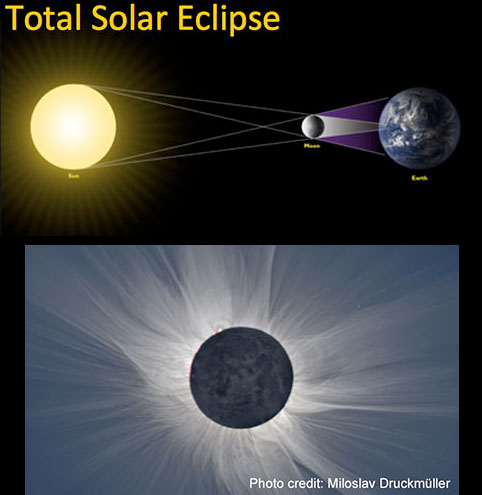 Solar eclipses come in three types: total, annular, and partial. (“Hybrid” means the same eclipse path includes some regions where the eclipse will be total and others where it will be annular.)
Total Solar Eclipses, 2017 Through 2050
This first table lists recent and upcoming total solar eclipses through 2050, with links to either Xavier Jubier’s interactive maps or the TimeandDate.com site maps for each for each.
| Date of Eclipse | Maximum Length of Totality (min:sec) |
Major Locations Crossed by Path of Totality |
| Monday, August 21, 2017 | 2:40 | USA |
| Tuesday, July 2, 2019 | 4:28 | Chile, Argentina |
| Monday, December 14, 2020 | 4:33 | Chile, Argentina |
| Saturday, December 4, 2021 | 1:54 | Antarctica |
| Thursday, April 20, 2023 (hybrid) | 1:16 | Australia, Indonesia |
| Monday, April 8, 2024 | 4:28 | Mexico, USA |
| Wednesday, August 12, 2026 | 2:18 | Greenland, Iceland, Spain |
| Monday, August 2, 2027 | 6:23 | Spain, Northern Africa, Arabian Peninsula |
| Saturday, July 22, 2028 | 5:10 | South Africa, Australia |
| Monday, November 25, 2030 | 3:44 | Australia |
| Friday, November 14, 2031 (hybrid) | 1:08 | Pacific Ocean |
| Wednesday, March 30, 2033 | 2:37 | Alaska |
| Monday, March 20, 2034 | 4:09 | Nigeria, Chad, Sudan, Saudi Arabia, Iran, Afghanistan |
| Sunday, September 2, 2035 | 2:54 | China, North Korea, Japan |
| Monday, July 13, 2037 | 3:58 | Australia, New Zealand |
| Sunday, December 26, 2038 | 2:18 | Australia, New Zealand |
| Thursday, December 15, 2039 | 1:51 | Antarctica |
| Tuesday, April 30, 2041 | 1:51 | Africa: Angola, DRC, Rwanda, Burundi, Uganda, Kenya |
| Sunday, April 20, 2042 | 1:51 | Indonesia, Philippines |
| Thursday, April 9, 2043 | 1:51 | Russia |
| Tuesday, August 23, 2044 | 1:51 | Canada, USA (northern Montana & North Dakota only) |
| Saturday, August 12, 2045 | 1:51 | USA |
| Thursday, August 2, 2046 | 1:51 | Africa: Angola, Botswana, South Africa |
| Saturday, December 5, 2048 (hybrid) | 1:51 | Chile, Argentina |
| Thursday, November 25, 2049 (hybrid) | 1:51 | Saudi Arabia, Yemen, Indonesia |
| Thursday, May 20, 2050 (hybrid) | 1:51 | southern Pacific Ocean |
Annular Solar Eclipses
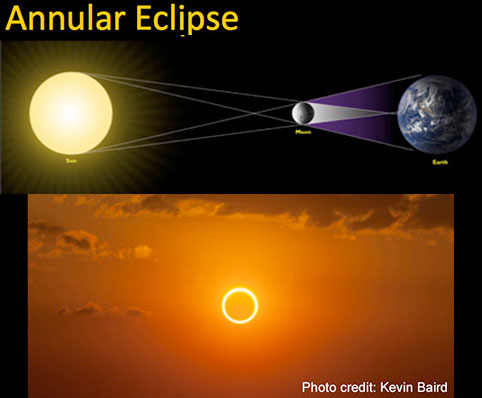 If a solar eclipse occurs when the Moon is relatively far from Earth in its orbit, its full shadow may not reach the Earth. In that case, locations directly behind the full shadow will see an annular eclipse, in which a ring of sunlight is still visible around the Sun at maximum eclipse. As a result, day does not turn into night like it does for a total solar eclipse, and there is never a time when you can look at an annular eclipse without eclipse glasses. The following table lists recent and upcoming annular solar eclipses through 2039, with links to Xavier Jubier’s interactive maps for each.
| Date of Eclipse | Major Locations Crossed by Path of Annularity |
| Saturday, October 14, 2023 | USA, Mexico, Central America, Colombia, Brazil |
| Wednesday, October 2, 2024 | Easter Island, Chile, Argentina |
| Tuesday, February 17, 2026 | Antarctica |
| Saturday, February 6, 2027 | Chile, Argentina |
| Wednesday, January 26, 2028 | Galapagos, Ecuador, Peru, Brazil, French Guiana |
| Saturday, June 1, 2030 | Greece, Turkey, Russia |
| Wednesday, May 21, 2031 | southern Africa, southern India, Indonesia |
| Wednesday, May 9, 2032 | southern Atlantic Ocean |
| Tuesday, September 12, 2034 | path across South America |
| Friday, March 9, 2035 | New Zealand, French Polynesia |
| Tuesday, January 5, 2038 | Caribbean, western Africa |
| Friday, July 2, 2038 | Columbia, Venezuela, western and central Africa |
| Tuesday, June 21, 2039 | Alaska, northern Europe |
Partial Solar Eclipses
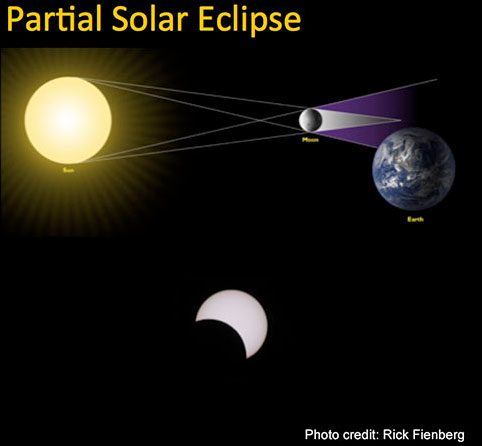 During a total or annular eclipse, locations that are within the Moon’s partial shadow will see a partial solar eclipse. In addition, sometimes the Moon’s full shadow passes above or below the Earth, in which case there is no path of totality or annularity on Earth, so the eclipse is partial only. Xavier Jubier has a list and map links for recent and upcoming partial-only solar eclipses.
Lunar Eclipses
Lunar eclipses are also worth watching. A lunar eclipse is generally visible to anyone on the night side of the world when it occurs. The following table lists recent and upcoming lunar eclipses through 2040, with links to maps showing where they can be seen from the Hermit Eclipse web site. The dates and times listed below are Universal Time (UT), also called Greenwich Mean Time (GMT) or Coordinated Universal Time (UTC), which you can convert to local time with web sites such as timeanddate.com.
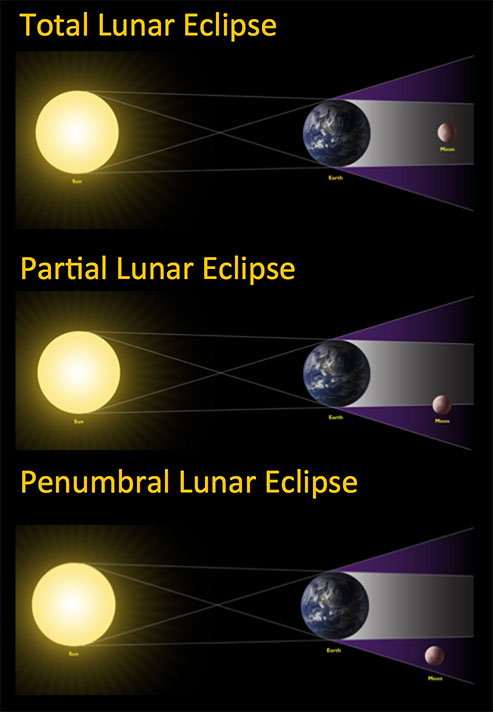
| Date/Time (UT) | Type | Where You Can See It |
| 28 Aug 2026 17:14–23:28 |
partial | Americas, W. Europe, Africa |
| 20 Feb 2027 02:36–07:48 |
penumbral | eastern Americas, Europe, Africa, Asia |
| 18 July 2027 18:43–00:17 |
penumbral | southeastern Africa, south Asia, Australia |
| 17 Aug 2027 17:07–21:12 |
penumbral | eastern Australia, New Zealand, Polynesia, Americas |
| 12 Jan 2028 17:45–21:04 |
partial | Americas, Europe, Africa |
| 6 July 2028 03:07–05:52 |
partial | Africa, Asia, Australia |
| 31 Dec 2028 07:32–11:53 |
total | Africa, Europe, Asia, Australia |
| 26 June 2029 08:47–13:49 |
total | Americas, western Europe, Africa |
| 20 Dec 2029 06:02–12:03 |
total | eastern Americas, Europe, Africa |
| 15 June 2030 06:02–12:03 |
partial | Europe, Africa, Asia, Australia |
| 09 Dec 2030 06:02–12:03 |
penumbral | Europe, Africa, Middle East, Asia |
| 07 May 2031 06:02–12:03 |
penumbral | Americas, western Europe, Africa |
| 5 June 2031 06:02–12:03 |
penumbral | Asia, Australia, New Zealand, western Americas |
| 30 Oct 2031 06:02–12:03 |
penumbral | Americas, eastern Asia, Australia, western Europe and Africa |
| 25 Apr 2032 06:02–12:03 |
total | east Asia, Australia, New Zealand and the Pacific |
| 18 Oct 2032 06:02–12:03 |
total | Europe, Asia |
| 14 Apr 2033 15:14–19:31 |
total | Europe, Africa, Asia, Australia |
| 08 Oct 2033 18:01–22:26 |
total | Asia, Australia, New Zealand, Americas |
| 03 Apr 2034 04:53–09:32 |
penumbral | Europe, Africa, Asia, Australia |
| 28 Sep 2034 00:41–04:47 |
partial | Americas, Europe, Africa |
| 22 Feb 2035 03:57–10:00 |
penumbral | east Asia, Australia, New Zealand, Americas |
| 19 Aug 2035 15:28–20:55 |
partial | Americas, Europe, Africa, western Asia |
| 11 Feb 2036 10:51–16:08 |
total | eastern Americas, Europe, Africa, Asia |
| 07 Aug 2036 10:51–16:08 |
total | Americas, Europe, Africa |
| 31 Jan 2037 10:51–16:08 |
total | North America, Asia, Australia, New Zealand |
| 27 July 2037 10:51–16:08 |
partial | Americas, western Europe, Africa |
| 21 Jan 2038 10:51–16:08 |
penumbral | Americas, Europe, Africa, western Asia |
| 17 June 2038 10:51–16:08 |
penumbral | Americas, Europe, Africa |
| 16 July 2038 10:51–16:08 |
penumbral | western Americas, east Asia, Australia, New Zealand |
| 11 Dec 2038 10:51–16:08 |
penumbral | Europe, Africa, Asia |
| 06 June 2039 10:51–16:08 |
partial | Europe, Asia, Australia, New Zealand |
| 30 Nov 2039 10:51–16:08 |
partial | Europe, Africa, Asia, Australia, New Zealand |
| 26 May 2040 10:51–16:08 |
total | Asia, Australia, New Zealand, western Americas |
| 18 Nov 2040 10:51–16:08 |
total | Europe, Asia, Australia |